Bedding · Andean Textiles · Interior Design
How St Geneve’s Baby Alpaca Throws Bring Andean Weaving into Modern Interiors
A throw can be a practical thing—an extra layer for a cold evening—or a small, persuasive argument for slowing down. In St Geneve’s Zuri and Bruno designs, baby alpaca, Peruvian craftsmanship, and quietly intricate patterns meet in textiles that make a room feel considered without asking it to make a fuss.
There is a familiar domestic scene: a chair chosen for its shape, a lamp selected for its light, a book left open to mark a page—and, over the chair’s arm, a blanket. The blanket is both decoration and invitation. It suggests that the room is not merely arranged but inhabited; that someone may sit down, stay awhile, and become comfortable. Its success depends on an agreeable contradiction. It must be noticeable enough to give the room texture, yet unassuming enough not to take it over.
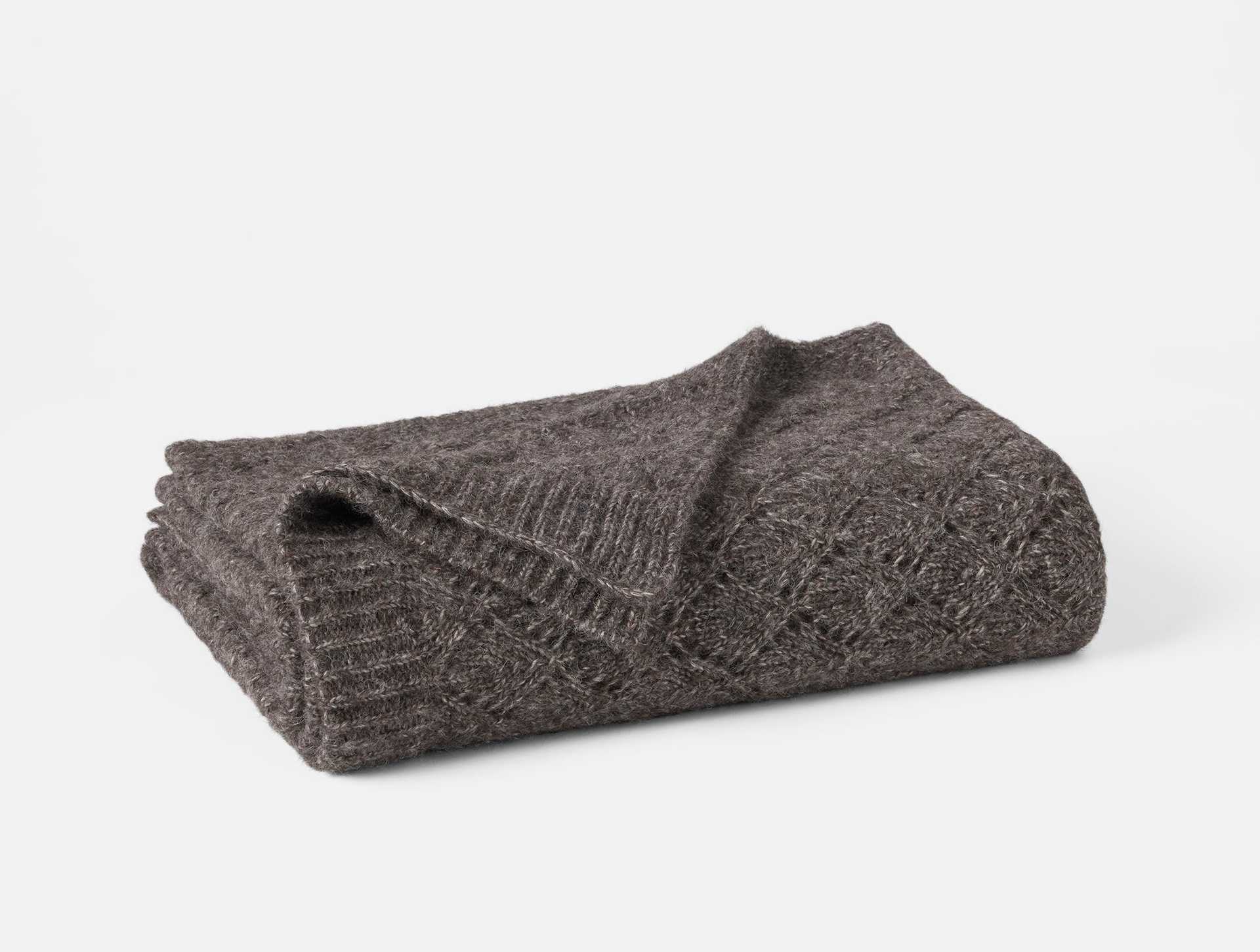
St Geneve’s Zuri and Bruno baby alpaca throws approach that balance through pattern. Zuri’s herringbone weave makes a fine, repeated diagonal movement across the fabric. Bruno’s labyrinth motif offers a more intricate geometry, one that rewards a closer look without becoming the whole story of a room. Made in Peru for St Geneve from baby alpaca, both throws draw on the expressive possibilities of woven cloth while remaining legible in contemporary interiors.
Their appeal is not simply that they are soft, or that they carry an association with the Andes. It lies in the way material, structure, and finish work together: the supple fall of alpaca, the shifting light on a patterned surface, the small boundary of fringe at an edge. To understand the throws is to look beyond the blanket as a color block and notice how a textile acquires character, one crossing thread at a time.
A fiber with a particular kind of softness
“Baby alpaca” is a quality designation for alpaca fiber, not necessarily a claim that the fiber came from a young animal. The distinction matters because the phrase can sound like an age description when it is used to communicate fineness. Alpaca is a natural animal fiber, and its feel depends on qualities such as fiber diameter, processing, yarn construction, and the way the cloth is made. A label alone cannot tell the entire story of a textile, but it points toward the character a maker intends: soft, light, and comfortable against the skin.
In a woven throw, softness is only one part of the experience. Alpaca can give the cloth warmth without requiring it to feel cumbersome. The resulting fabric may settle over a sofa back or the corner of a bed with a fluidity that is different from the stiffer fall of a heavier, more compact blanket. That drape is practical—an easy way to add a layer—and visual, too. A fabric that bends and folds readily produces soft contours rather than rigid lines.
Fiber characteristics should not be treated as guarantees of performance for every person or household. Sensitivity varies, and the comfort of a finished textile depends on more than its fiber name. Still, the combination of alpaca and a considered weave can make a throw appealing as a layer used close to the body: over the legs while reading, across the shoulders on a cool morning, or at the foot of a bed when the room calls for one more source of warmth.
There is also a difference between softness as a first impression and softness as an ongoing quality. A new textile meets the hand with the promise of an easy relationship; its longevity depends on use, maintenance, and construction. For a cherished throw, the useful questions are less glamorous than the first touch: How should it be cleaned? Where will it be stored? Will it be used every day, or brought out for particular occasions? Luxury is not only an adjective. It is a relationship between an object and the life it has to withstand.
What a weave contributes
Weaving is an arrangement of interlaced yarns. The warp runs lengthwise on the loom; the weft travels across it. Different orders of interlacement produce different surfaces, patterns, and degrees of structure. A familiar pattern may seem to appear on the cloth all at once, like a drawing. In fact, its visual rhythm is made from repeated decisions about where threads pass over and under one another.
Herringbone is among the most approachable results of that logic. Its diagonal lines reverse direction at intervals, creating the recognizable broken zigzag associated with the pattern’s name. In Zuri, the herringbone gives the throw movement without relying on a large, high-contrast design. Seen from across a room, it reads as texture; at closer range, the orderly changes of direction become more apparent. It has the useful manners of a good supporting actor: present, capable, and not forever stepping into the light.
The pattern is old in the broad sense that versions of it have appeared in textiles and other materials across many times and places. But a pattern’s history should not be treated as a single, simple lineage. Similar structures can arise in different traditions, and a motif’s resemblance to a historical pattern does not establish a direct connection to a specific culture or period. In a contemporary throw, herringbone is best understood first as a weaving structure with a long visual life and a distinctly adaptable character.
Bruno’s labyrinth motif has a different temperament. Its geometry is more elaborate, guiding the eye along paths that turn and return. Repetition provides coherence; small changes in direction keep the surface from becoming static. The result can feel almost architectural, though it is made from thread rather than stone or line on paper. Like a patterned floor or a tiled wall, it gives a surface a sense of order. Unlike either, it can be folded, draped, and gathered into a new arrangement.
Pattern on a throw is especially intimate because the textile rarely stays in one fixed position. A Bruno throw may lie flat for a moment, then acquire ridges and soft shadows when someone draws it over a lap. The motif changes with the folds. A tablecloth is usually asked to behave; a throw is permitted to wander. Its design must survive both conditions—display and casual use—and a woven pattern can offer depth without depending on a rigid, perfectly flat presentation.
Made in Peru, read in the present
St Geneve’s throws are made in Peru, a detail that situates them within a broader world of Andean textiles and Peruvian textile production. It is worth being precise about what such a statement does and does not tell us. “Made in Peru” identifies a country of manufacture. It does not, by itself, specify the community, workshop, individual weavers, techniques, or full path by which fiber became finished cloth. Those details deserve attention when they are available, but they should not be supplied by imagination.
The Andes have long been associated with sophisticated textile practices, and woven objects have held practical and cultural importance across the region. Yet Andean textile history is not one uninterrupted, uniform tradition. It encompasses many communities, techniques, materials, designs, and periods. A modern alpaca throw can be understood in relation to this larger setting without pretending that every contemporary pattern is a direct survival of a particular ancient design.
That distinction allows cultural appreciation to become more thoughtful rather than less. It asks a buyer or reader to notice what is documented: the stated material, the stated place of manufacture, the named construction, and any available information about sourcing and production. It also leaves room for uncertainty. A finely made textile can be admired for its beauty while questions about labor, provenance, and supply chains remain legitimate. Respect begins with curiosity and with the refusal to mistake a broad regional reference for a complete account.
For an interior, the Peruvian origin is not merely a decorative theme. It is part of the object’s material and production context. But a room does not have to become a museum display of supposed “Andean style” in order to make space for the throw. Zuri and Bruno can sit comfortably among modern furniture, plain bedding, or older pieces because their design is based on texture and pattern rather than a demand for a whole room to repeat a single visual language.
A small design decision with a large effect
Textiles alter a room in ways that are almost embarrassingly efficient. A throw introduces color, softness, and visual weight without the commitment of new upholstery or a painted wall. It can make a large sofa seem less formal, a spare bedroom more welcoming, or a reading chair more like a destination. And because it can be moved, it offers a form of decoration that remains open to revision.
Zuri’s herringbone is a natural fit for interiors where a pattern is welcome but visual quiet matters. It can sit beside solid-color cushions, join other small-scale patterns, or soften the smooth planes of contemporary furniture. The pattern’s repeating diagonals create interest, but they do not usually compete with large artwork or a strongly colored rug. In a neutral room, they offer something for the eye to discover; in a more layered room, they can become part of a larger conversation among surfaces.
Bruno, with its labyrinth motif, can act as a more defined accent. It may suit a room whose furnishings are relatively restrained, where a single patterned textile can carry some of the visual complexity. In a room already full of print, texture, and color, it can work too—but the surrounding pieces should give the eye places to rest. Pattern mixing is less a matter of obeying a rule than of balancing scale, color, and density. A compact motif beside a larger pattern often feels more legible than two equally insistent designs.
Color matters, though not in isolation. A muted throw may feel lively against a dark sofa and almost invisible against a pale one. A textured edge can stand out more clearly than the center of the cloth. Lighting also changes what a woven surface appears to be: daylight brings out fine distinctions, while lamplight gathers the pattern into softer contrasts. The throw is not a fixed picture but a surface with a changing audience, including the hour of the day.
Placement is another kind of styling, and it need not be elaborate. Fold a throw in thirds over the arm of a chair if you want a neat line; drape it loosely if the room benefits from a more relaxed note. At the foot of a bed, it can establish a final layer without competing with the duvet. On a sofa, it can be arranged as an invitation rather than a showroom gesture. The trick is to avoid folding it so meticulously that it appears to have been placed there by someone afraid to use it.
Fringe, drape, and the finishing touch
The finish at a textile’s edge can seem like a minor matter until it is missing. Fringe changes the silhouette of a throw, softening a straight boundary and adding a little movement. St Geneve’s Zuri and Bruno are described with an eyelash fringe, a delicate finish whose fine strands create a light, tactile edge. It is decorative, certainly, but it also makes the perimeter feel less like a seam on a flat object and more like the final gesture in a piece of cloth.
Fringe is most effective when it supports, rather than overwhelms, the weave. On a patterned textile, a finely scaled edge can provide a pause after the motif has occupied the center. It also becomes visible in use: when the throw is folded, the fringe marks its outline; when it is draped, the edge may hang freely and move with the cloth. These details are small in the way punctuation is small. Their effect depends on where they appear and how they help the whole read.
Construction and finishing details also influence a throw’s day-to-day life. A loosely arranged drape can expose the edge to more handling; a throw folded neatly may receive less friction in certain places and more in others. This is no reason to treat a blanket like a fragile artifact. It is a reason to read care instructions before purchase and to decide whether the recommended maintenance fits the way the household actually lives.
Caring for alpaca without drama
The Zuri and Bruno product information specifies dry cleaning. That guidance should take precedence over general advice about alpaca or wool, because the finished textile—not simply the fiber—determines how it should be cared for. The weave, dyes, fringe, and finishing can all affect the outcome of cleaning. When a manufacturer recommends professional cleaning, an at-home wash may change the fabric’s dimensions, texture, or finish in ways that are difficult to reverse.
Between cleanings, a little restraint can go a long way. Airing a throw in a clean, shaded place can help it feel refreshed after ordinary use. Avoid leaving it in strong direct sunlight for long periods, especially if color retention is a concern. Keep it away from damp storage areas, and make sure it is fully dry before putting it away. When the season changes, store it clean in a dry, breathable space rather than compressing it indefinitely under heavy objects.
Regular handling may produce loose fibers or small snags over time. Resist the impulse to pull a snag: doing so can distort the weave around it. A specialist cleaner or textile conservator can advise on repairs when an issue goes beyond simple surface care. For moth prevention, keep storage areas clean and inspect natural-fiber textiles from time to time. These are ordinary precautions, not evidence that a good blanket should be kept under glass.
The broader lesson is that maintenance belongs in the design conversation. A throw that is meant to be used deserves care instructions a household can follow. If dry cleaning feels impractical, that may be a reason to reserve the piece for occasional use—or to choose a different kind of textile for a room where blankets face frequent spills and regular laundering. The right choice is not always the most luxurious-sounding one. It is the one whose beauty and upkeep fit together.
Choosing between Zuri and Bruno
The two designs invite a simple comparison. Choose Zuri if a clear, familiar rhythm is appealing: its herringbone offers visible texture without a dense, highly articulated motif. Choose Bruno if you want the pattern itself to hold attention for longer, with a labyrinth design that brings more graphic intricacy. Neither pattern is inherently more formal, more traditional, or more versatile in every setting. The answer depends on what the room already contains and what you want the throw to contribute.
There are practical questions, too. Consider whether the throw will be used mainly for warmth or displayed as an accent; whether its dimensions suit the chair, sofa, or bed; and whether its care requirements are realistic. Think about the textures already present. A smooth leather sofa may benefit from the visual softness of woven alpaca. A heavily textured bouclé chair may call for a pattern that adds contrast without making the composition feel crowded.
It can help to look at the textile from several distances. From across the room, does the pattern register as a calm field, a distinct geometric accent, or a blur? Up close, does the weave reward attention? This two-scale test is useful because a throw is rarely seen only one way. It is encountered at the room’s far end, from the sofa, in someone’s hands, and in the folds left behind after use.
As with any purchase described in terms of ethical sourcing or natural materials, clear information matters. Ask what is known about the fiber’s origin, where and how the textile was made, and what standards or certifications—if any—apply. A product description should be read for what it actually states, not for every assurance a reader hopes it implies. Careful questions do not diminish pleasure. They make it possible to enjoy an object with a fuller sense of what is known about it.
The enduring appeal of a useful object
The most successful textiles in a home are not always the loudest or the rarest. They are often the ones that remain welcome through changes in taste: a chair reupholstered, a bedroom repainted, a new apartment with a different arrangement of windows. A restrained weave can travel through those shifts because it does not depend on a single moment’s idea of fashionable color or pattern.
St Geneve’s Zuri and Bruno throws make a case for looking closely at that quieter kind of design. Their baby alpaca fiber gives them a soft, warm character; their herringbone and labyrinth patterns create distinct visual rhythms; their fringed edges finish the cloth with a touch of movement. Made in Peru, they also invite attention to the traditions and contemporary work of Andean textile production—an invitation best answered with appreciation, specificity, and a willingness to learn more.
A throw cannot explain every stage of its own making. It can, however, give us something to notice: the direction of a diagonal, the way a motif turns, the weight of a fold, the edge where threads become fringe. In the everyday life of a room, those small observations are often enough. The blanket is taken down from the chair, unfolded, and used. Its pattern changes shape in the hands. A crafted object becomes a domestic one—not by losing its history, but by joining the present tense of the home.